
Allowlisted actions only
AI output never goes straight to a shell, cloud API or cluster. It selects from validated runbooks.
FluxMigrate designs and builds AIOps across eight operational domains. Signals become decisions, decisions pass policy, approved actions run from validated runbooks, and every outcome is verified and recorded.
Talk to an AIOps Specialist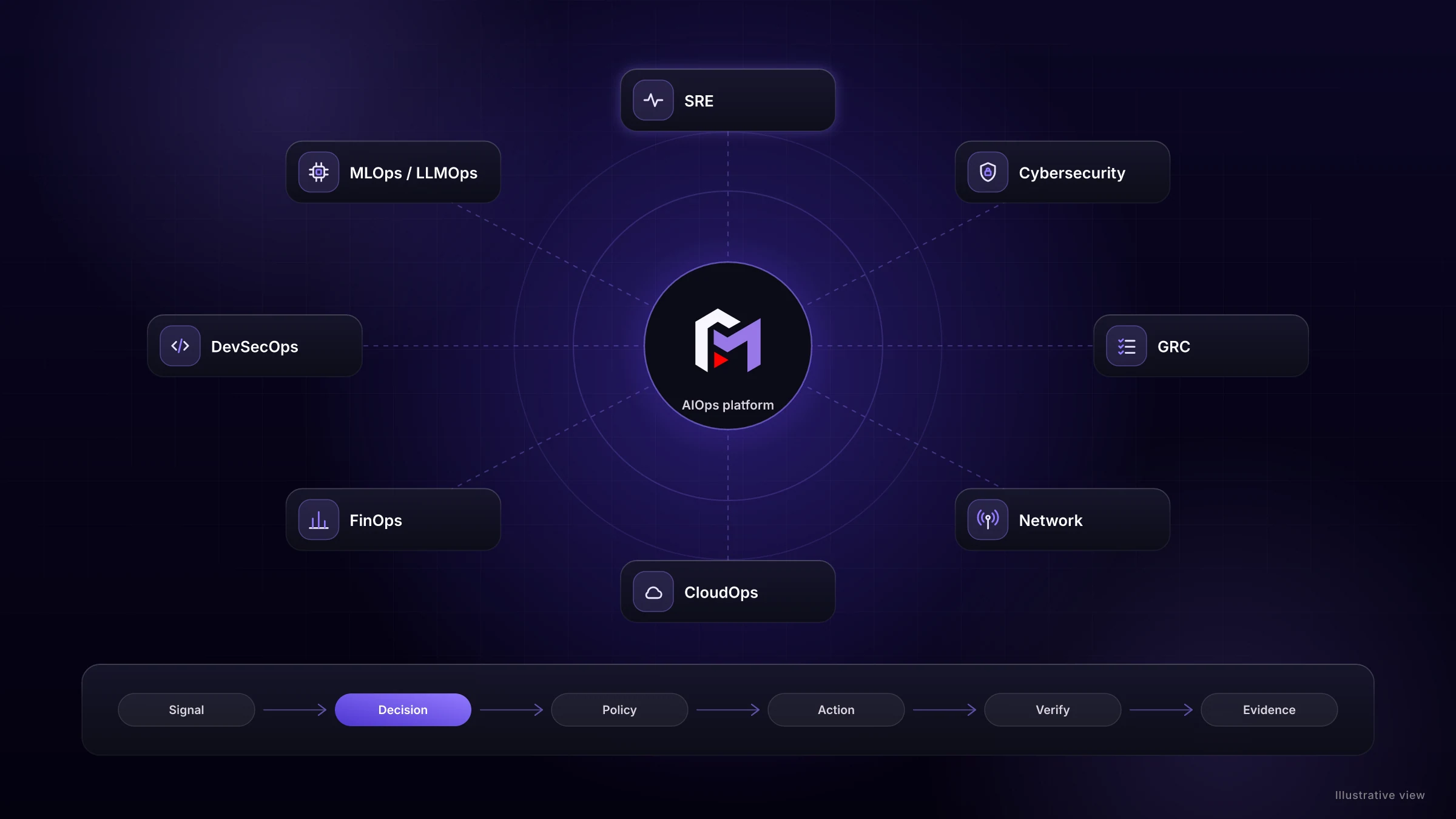
Each track is a set of five services. Take one on its own, or combine tracks so telemetry, policy and runbooks are shared.

Reliability, SLOs, incident intelligence, predictive operations and self-healing across hybrid environments.
View the five services: SRE AIOps
AI-assisted threat detection, security-event correlation, behavioral analytics and governed response.
View the five services: Cybersecurity AIOps
Continuous compliance, automated evidence, risk analytics and policy-as-code across hybrid infrastructure.
View the five services: GRC AIOps
Topology-aware observability, prediction, root-cause analysis and safe automation across WAN, cloud and Kubernetes networking.
View the five services: Network AIOps
Hybrid and multi-cloud inventory, health analytics, drift intelligence, workload placement and governed remediation.
View the five services: CloudOps AIOps
Cost anomaly detection, rightsizing, forecasting and allocation that respect reliability targets.
View the five services: FinOps AIOps
Software-delivery reliability, AppSec prioritization, supply-chain protection and secure release automation.
View the five services: DevSecOps AIOps
Reliability, observability, governance and capacity for ML models, LLM applications and AI agents.
View the five services: MLOps / LLMOps AIOpsWhatever the domain, the same chain runs from first signal to final evidence.
Collect and normalize telemetry, events and findings from the systems you already run.
Detect, correlate and score. Start with rules and statistics; add machine learning where it earns its place.
Check risk, ownership and approval rules before anything changes.
A person approves disruptive or high-risk actions by default.
Run a validated, allowlisted runbook under a least-privilege identity.
Check service health after the action and roll back if it did not help.
Keep the decision, approval, action and result as an audit trail.
Record overrides and outcomes so scoring improves and stays explainable.
AI output never goes straight to a shell, cloud API or cluster. It selects from validated runbooks.

Disruptive actions wait for a person. Low-risk, reversible steps can run on their own once you agree the rule.

Every action is followed by a health check, with rollback or compensation when the check fails.

Signals, scores, model or rule versions, approvals and results are retained and reviewable.
Reliability, SLOs, incident intelligence, predictive operations and self-healing across hybrid environments.
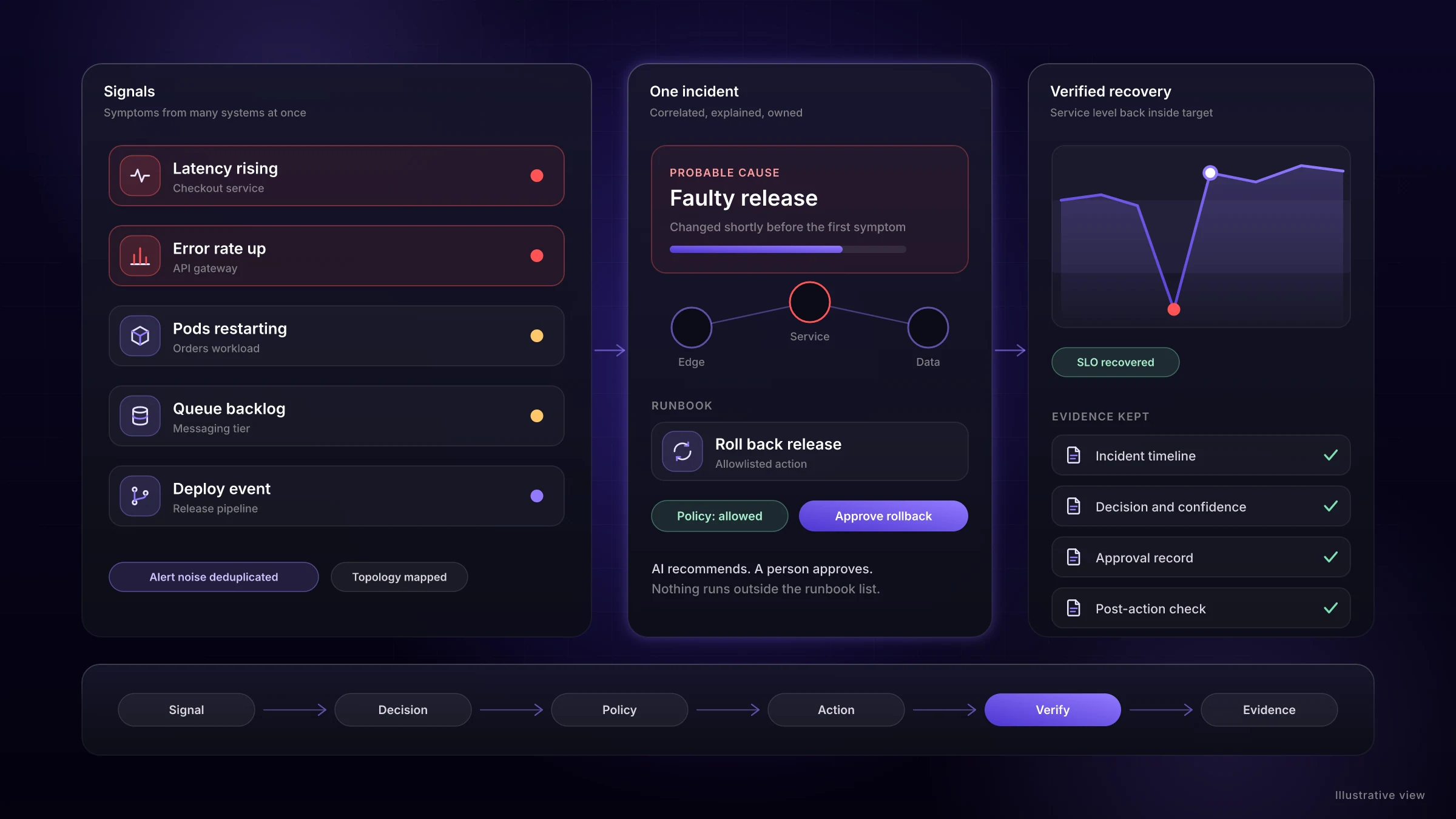
Unify multi-site and cloud telemetry, correlate incidents, find probable root cause and coordinate safe remediation.
Detect recurring failures and run policy-controlled remediation with verification.
Forecast capacity exhaustion and SLO risk before static thresholds are breached.
Score code, IaC and Kubernetes changes, control progressive delivery and roll back unhealthy releases.
Prove DR readiness, backup restorability, failover and RTO/RPO through safe experiments.
Example scenario
A faulty release is injected. Several symptoms collapse into one incident, a rollback is approved and SLO recovery is verified.
AI-assisted threat detection, security-event correlation, behavioral analytics and governed response.
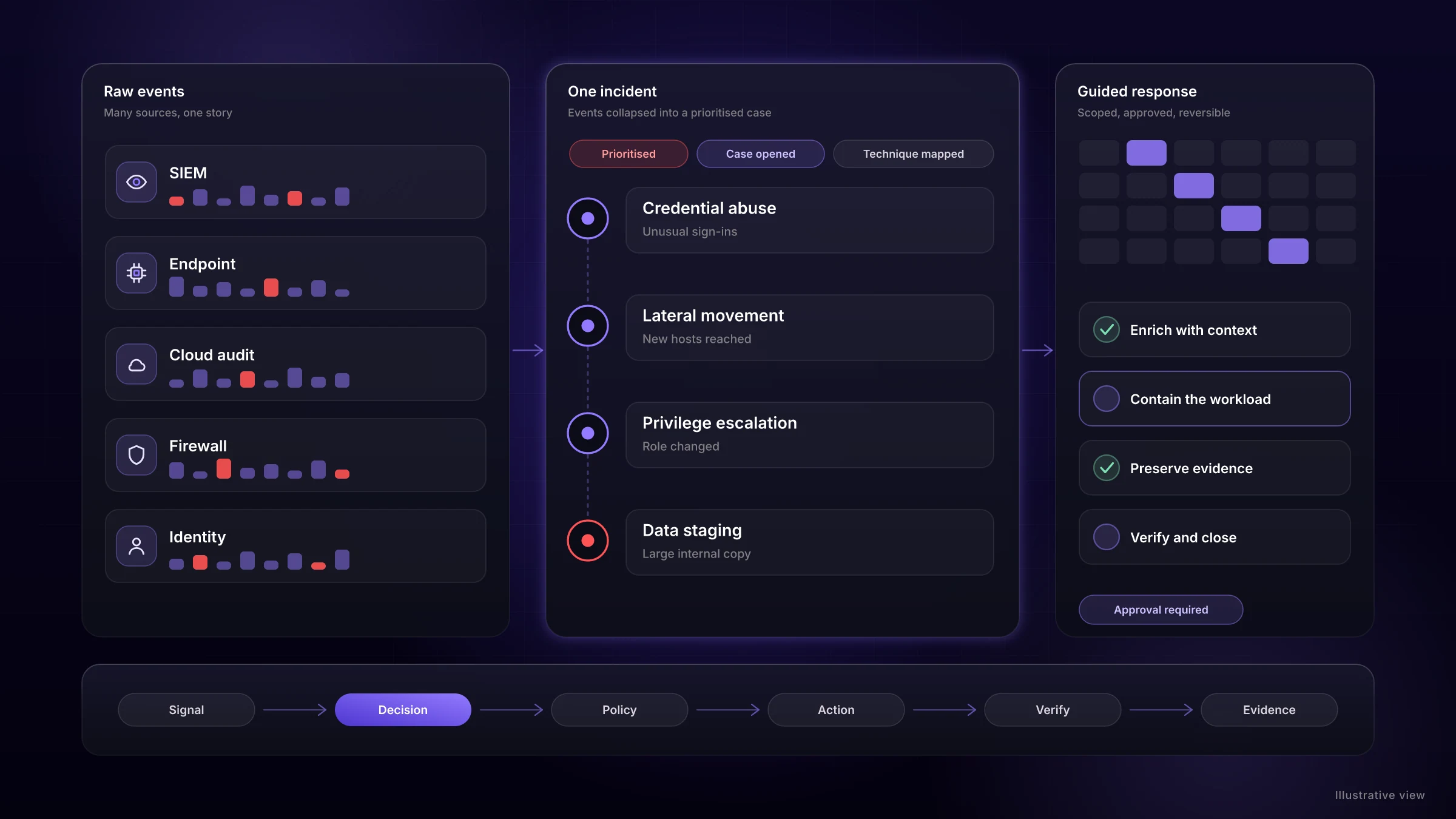
Turn SIEM, EDR, cloud, firewall and identity alerts into prioritized incidents with guided response.
Rank vulnerabilities by exploitability, exposure, runtime context and asset criticality.
Spot suspicious user and service-account behavior against learned login and privilege baselines.
Detect runtime and control-plane threats and apply tightly scoped containment.
Automate safe enrichment, classification and case creation for suspicious messages, files and URLs.
Example scenario
Credential abuse followed by lateral movement is simulated. Raw events collapse into one incident with a guided response.
Continuous compliance, automated evidence, risk analytics and policy-as-code across hybrid infrastructure.
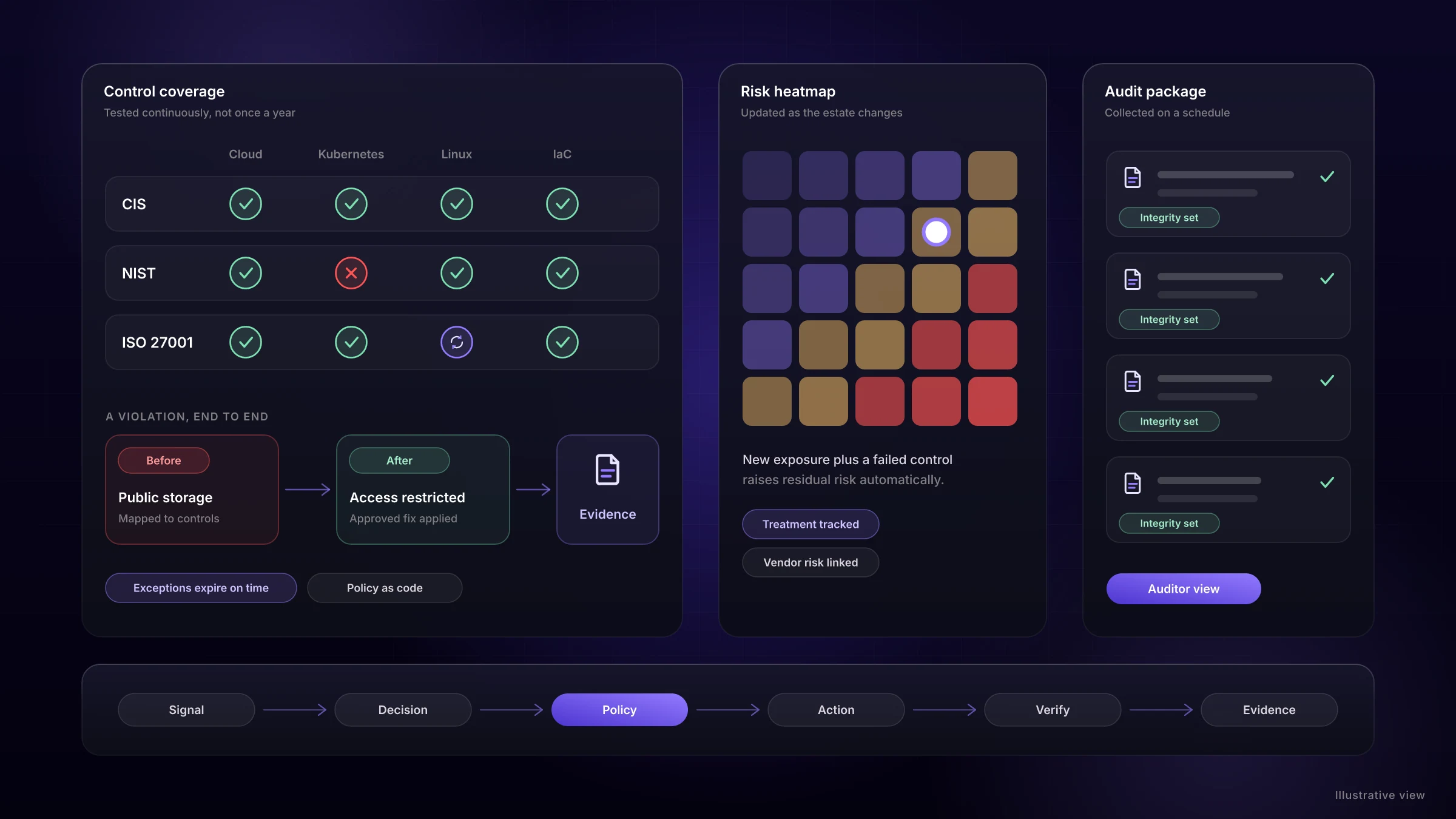
Test cloud, Kubernetes, Linux and IaC against mapped controls and fix approved violations.
Replace manual evidence collection with scheduled collectors and automated control tests.
Update operational risk from incidents, vulnerabilities, failed controls and asset criticality.
Turn governance requirements into executable policy for CI/CD, cloud and Kubernetes.
Track vendor risk using attestations, SLA incidents, questionnaires and approved external inputs.
Example scenario
A known violation is introduced, mapped to controls and remediated, with before and after evidence.
Topology-aware observability, prediction, root-cause analysis and safe automation across WAN, cloud and Kubernetes networking.
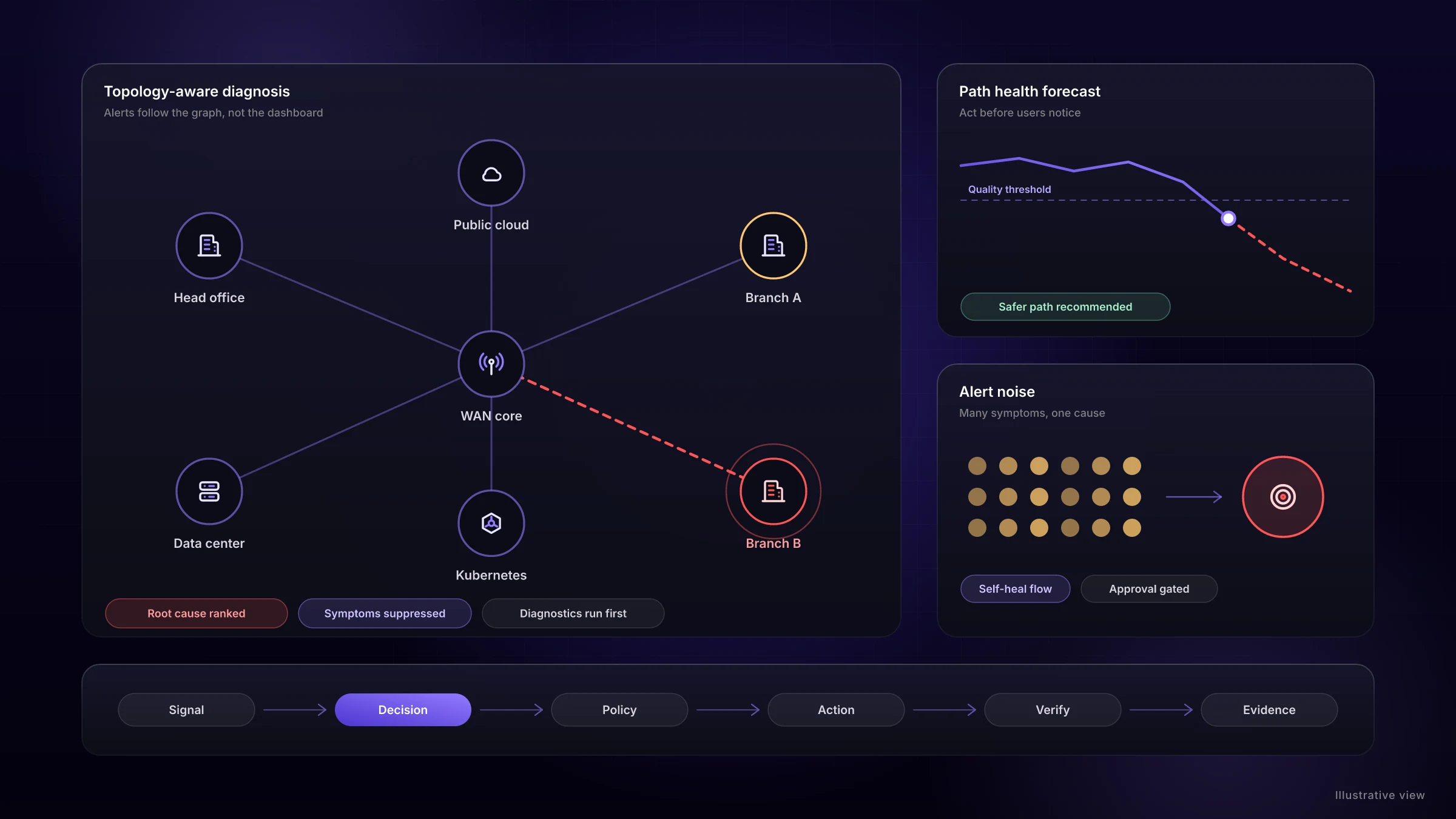
Unify health, topology, incidents and automation for enterprise, cloud and Kubernetes networks.
Forecast path degradation from latency, loss, jitter and utilization and recommend safe path changes.
Suppress downstream symptoms, rank the probable root cause and run approved repair workflows.
Detect risky firewall, security-group and network-policy drift and conflicting rules.
Correlate CNI, DNS, ingress, NetworkPolicy and mesh signals to diagnose cluster networking failures.
Example scenario
One upstream failure raises many alerts. The actual root cause is identified and the downstream symptoms are suppressed.
Hybrid and multi-cloud inventory, health analytics, drift intelligence, workload placement and governed remediation.
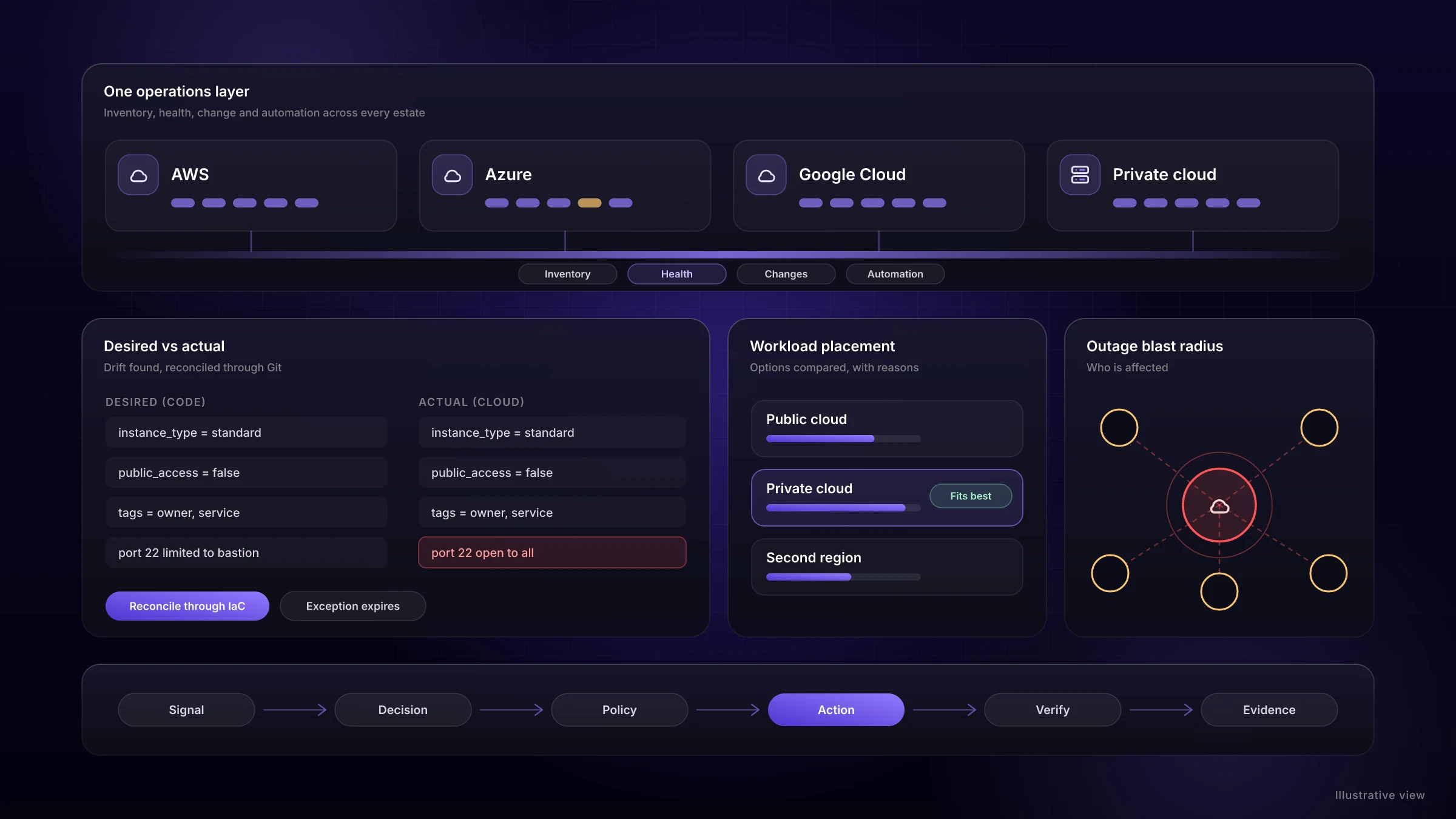
One operations layer for AWS, Azure, GCP and private-cloud inventory, health, incidents, changes and automation.
Detect unhealthy cloud resources and recover them under policy control.
Compare cloud state with desired IaC and policy and safely reconcile drift.
Recommend placement from capacity, latency, availability, policy and cost inputs, with reasons.
Map applications to cloud dependencies, correlate provider events and estimate blast radius.
Example scenario
Console drift is created, then the intended state is restored through Git and IaC.
Cost anomaly detection, rightsizing, forecasting and allocation that respect reliability targets.
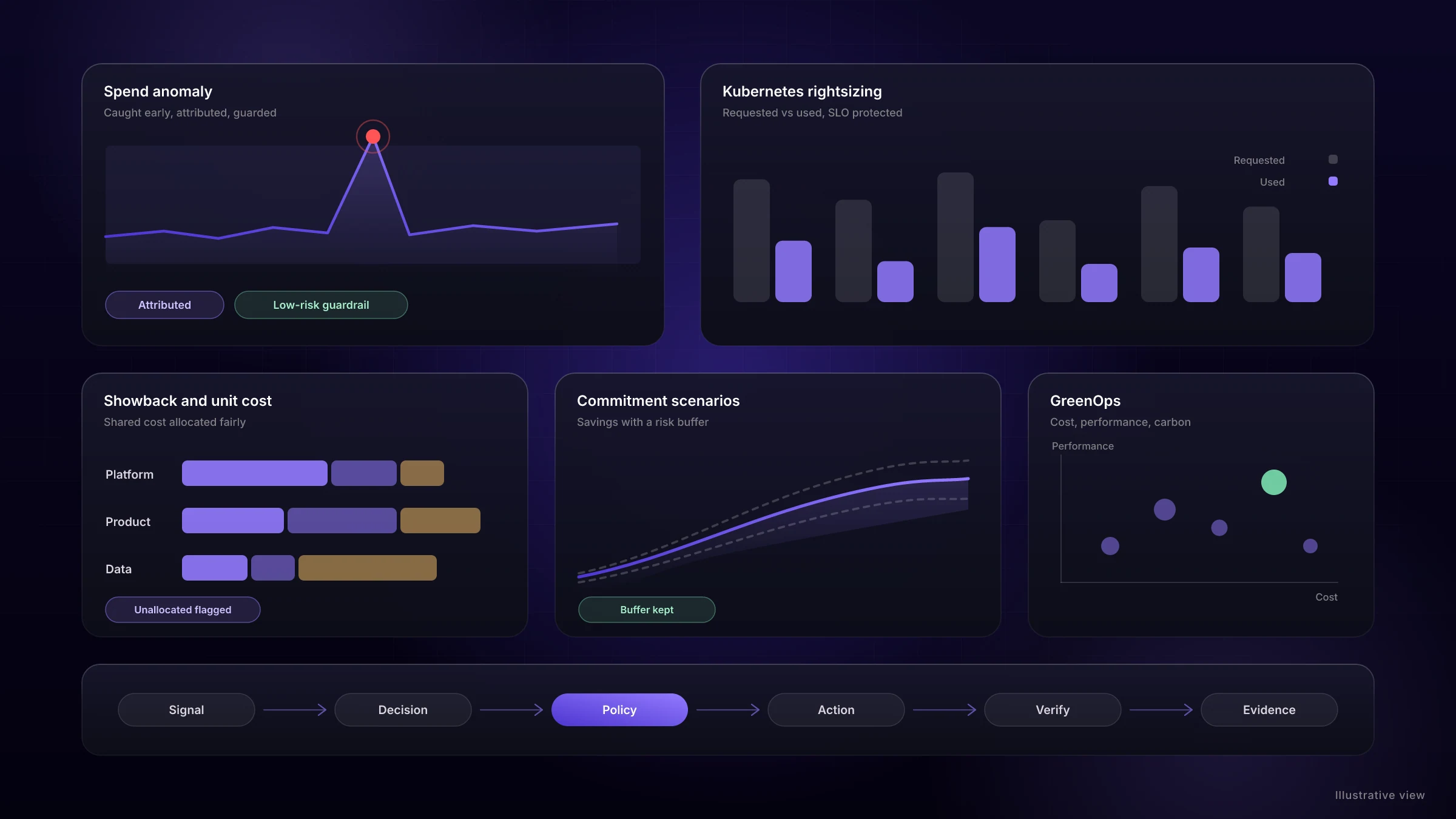
Detect abnormal spend early and trigger governed cost-control workflows.
Tune CPU and memory requests, limits and replicas from real utilization while protecting SLOs.
Forecast stable usage and model commitment scenarios with risk buffers.
Allocate shared cost and calculate cost per service, customer, transaction or team.
Balance cost, performance, utilization and sustainability signals within SLO limits.
Example scenario
A synthetic spend spike is injected. It is detected, attributed and met with a low-risk guardrail.
Software-delivery reliability, AppSec prioritization, supply-chain protection and secure release automation.
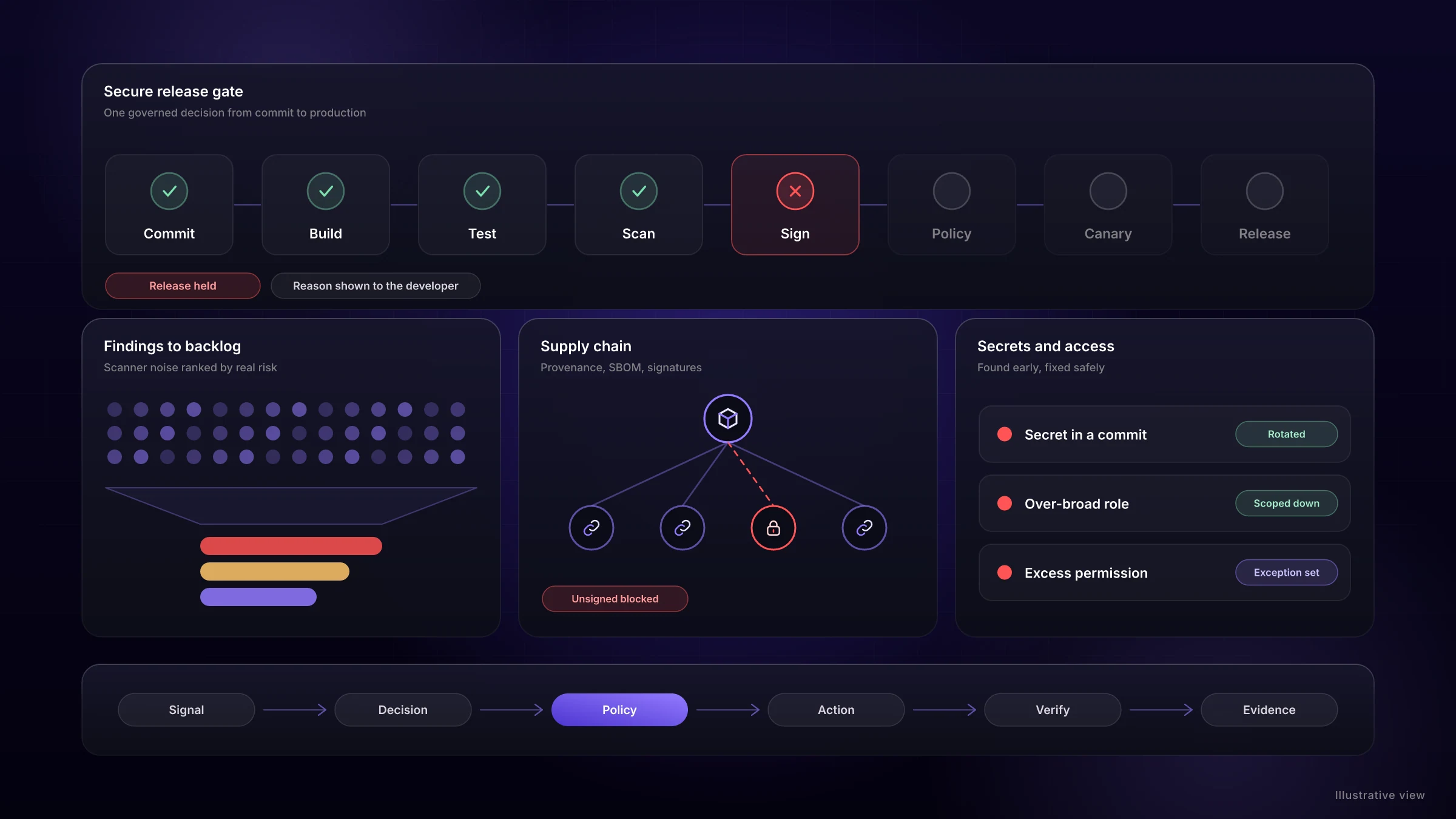
Classify pipeline failures, spot flaky and transient issues and recommend safe recovery.
Deduplicate and rank SAST, DAST, dependency, container and IaC findings by exploitability and context.
Track SBOMs, provenance, artifact signatures, dependencies and build integrity.
Combine tests, security, IaC policy, live SLO health and change risk into one governed release gate.
Find exposed secrets and excessive permissions across code, CI/CD, Kubernetes and cloud configuration.
Example scenario
A healthy release and a risky one are compared and receive different promotion outcomes.
Reliability, observability, governance and capacity for ML models, LLM applications and AI agents.
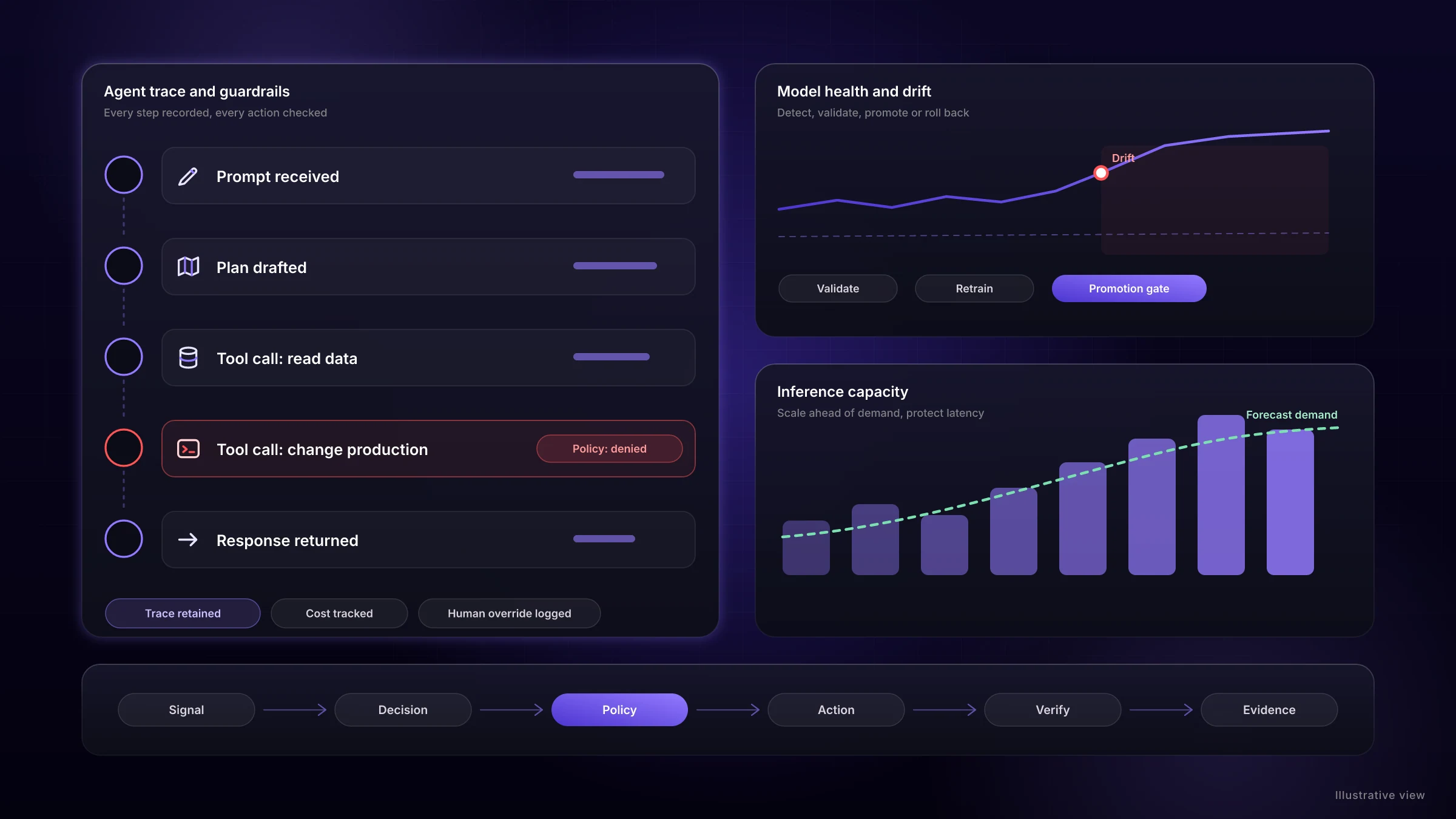
Operate model endpoints with SLOs, quality signals, version context and safe rollback.
Trace prompts, tokens, tool calls and agent steps while enforcing operational policy.
Forecast inference demand and tune scaling, batching and placement while protecting latency.
Detect feature, prediction and performance drift and trigger validation and retraining pipelines.
Monitor model, prompt and tool policy compliance, data handling and AI-system risk.
Example scenario
An agent attempts a disallowed action. Policy intercepts it and the trace shows exactly why.
We build locally with realistic synthetic data first, then extend to your private cloud and to AWS, Azure or GCP.

Rules and statistics first, so every decision can be explained before machine learning is added.

Healthy, faulty, false-positive, policy-blocked and failed-automation cases are exercised before production.

Adapters for your clouds, clusters, networks and tools, using Terraform, Ansible and Helm.

Dashboards, runbooks, tests and a demo script your team can operate and extend.
Tell us what you run and where operations hurt most. We will suggest where to start.
Talk to an AIOps Specialist